
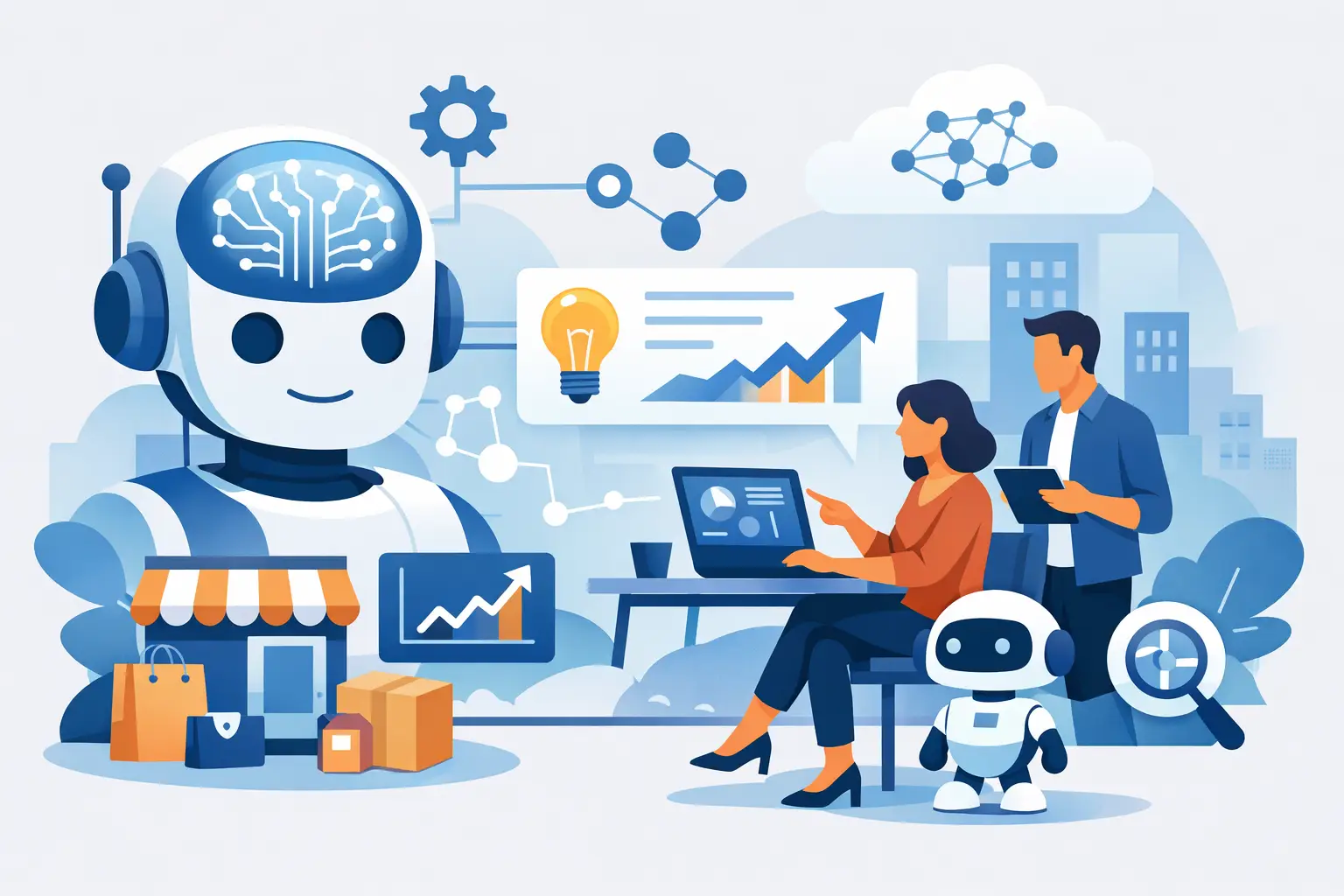
A small business owner does not need to become a programmer to benefit from artificial intelligence. They need more time to lead, more clarity to make decisions, and more capacity to serve customers well. That is the promise behind this guide to AI for small business: not replacing the people who built the company, but giving them stronger tools to build what comes next.
For many owners, AI arrives with two competing emotions: curiosity and concern. The concern is understandable. Technology changes jobs, customer expectations, and the pace of competition. But for a local service provider, independent consultant, retailer, contractor, or growing online business, AI can also be a practical force for freedom. It can take routine work off your plate so you can focus on judgment, relationships, and growth.
The opportunity is not to use AI everywhere. The opportunity is to use it where it creates a real advantage.
Start With the Work That Slows You Down
The best first question is not, "Which AI tool should I buy?" Ask, "What repetitive work keeps my business from moving forward?"
Look at a typical week. You may spend hours drafting customer emails, summarizing meetings, responding to common questions, creating social media posts, preparing proposals, organizing notes, or reviewing basic sales data. These are not unimportant tasks. They are necessary tasks that can consume the energy needed for higher-value work.
AI is especially useful when a task is repeatable, text-heavy, time-consuming, and still requires your final review. For example, a landscaping company can use it to create a first draft of seasonal customer outreach. A financial coach can use it to turn a recorded client call into organized notes and follow-up actions. A boutique retailer can use it to generate several product-description options, then choose and refine the version that sounds like the business.
That last part matters. AI can create a first draft quickly. It should not be treated as the final decision-maker. Your experience, standards, and understanding of your customers are what turn a usable draft into good business communication.
A Guide to AI for Small Business: Choose One Clear Win
Small businesses often lose momentum by trying to modernize everything at once. A better approach is to choose one workflow where a modest improvement can be measured within 30 days.
Start with a simple goal. Perhaps you want to reduce the time spent writing estimates, respond faster to customer inquiries, produce consistent weekly marketing content, or make internal training easier for new employees. Pick a process that happens often enough to matter, but is not so sensitive that a mistake would cause serious harm.
Then establish a baseline. If creating a proposal currently takes two hours, track that time for several jobs. If customer replies are inconsistent, note your average response time and the questions people ask most often. Without a baseline, it is easy to be impressed by a new tool without knowing whether it actually improved the business.
After that, test AI on a limited set of tasks. Give it real context: your service, your audience, your offer, your tone, and the result you want. Vague prompts usually produce vague work. Clear instructions produce more useful starting points.
A home remodeling business, for instance, might ask AI to draft a follow-up email for a homeowner who requested a kitchen renovation estimate. The owner can specify the company voice, the typical project timeline, the next step, and the concerns the customer may have. That is far more effective than asking for a generic sales email.
Measure the result in plain business terms. Did it save time? Did it improve consistency? Did it help the team follow up more quickly? Did customers respond positively? If the answer is no, adjust the process or move on. AI should earn its place in your operation.
Keep People in Charge of the Customer Experience
Customers can tell when communication feels generic, careless, or strangely impersonal. That is why the strongest small-business use of AI is often behind the scenes.
Use it to prepare, organize, brainstorm, and speed up routine work. Let people handle the conversations where trust is built. A customer dealing with a billing problem, a delayed project, a health concern, or a major purchase wants accountability from a real person. No automated response can replace calm judgment and genuine care in a high-stakes moment.
This is not a limitation of AI. It is a competitive advantage for businesses that understand the difference. When technology handles administrative drag, your team has more time to listen, solve problems, and follow through. Those are the experiences customers remember.
Set clear internal rules before AI becomes part of daily work. Decide which communications require human approval, which customer information should never be entered into public AI tools, and who is responsible for checking factual accuracy. A simple policy protects the business and gives employees confidence about how to use the technology responsibly.
Protect Your Data and Your Reputation
AI can be useful, but convenience should never outrun common sense. Do not paste private client records, passwords, bank details, employee files, medical information, or confidential contracts into a tool unless you fully understand its data policies and have approval to do so.
The same caution applies to accuracy. AI can make errors with confidence. It may invent a detail, misunderstand a question, or produce language that sounds polished but does not reflect your actual policies. Any content involving pricing, legal issues, financial guidance, compliance, or customer promises deserves close human review.
Think of AI as an energetic assistant with impressive speed but no personal accountability. It can help organize the work. You remain responsible for the outcome.
This mindset also protects your brand. Every message sent under your company name should sound like it came from people who know what they are doing and care about the result. A few extra minutes of review can prevent a costly misunderstanding.
Build AI Skills Across the Team
The businesses that benefit most from AI will not necessarily be the ones with the biggest technology budgets. They will be the ones that develop better habits of learning.
Encourage employees to identify one part of their role where AI could reduce repetitive work. Let them test ideas within clear boundaries, share what worked, and explain what did not. This turns AI from a top-down threat into a shared capability.
Training should focus on practical judgment, not technical jargon. Team members need to know how to ask useful questions, verify outputs, protect sensitive information, and recognize when a human decision is required. Those abilities will matter in nearly every industry.
There may be resistance, especially if employees fear that AI is being introduced to eliminate their jobs. Address that directly. The goal should be to strengthen people, remove frustrating busywork, and prepare the business for a changing market. If a role evolves, invest in helping the person evolve with it.
That is a more durable version of progress. A company cannot build long-term loyalty by treating its people as disposable. It can build momentum by helping them become more capable.
Use AI to Think Bigger, Not Just Work Faster
Saving time is valuable, but the larger opportunity is strategic. AI can help a small business owner examine customer feedback, spot recurring objections, generate ideas for new offers, prepare for sales conversations, and explore markets that once seemed too difficult to reach.
Still, more ideas do not automatically create better decisions. AI can produce ten marketing angles in seconds, but only you can decide which one fits your values, customers, and capacity. Growth that outpaces quality can damage a reputation just as quickly as stagnation can limit opportunity.
Use the extra capacity AI creates to ask better questions. What do customers need that competitors overlook? Which services create the most value and profit? Where is the team losing time? What knowledge should be documented so the business is less dependent on one person?
These are leadership questions. AI can help you prepare answers, but it cannot replace the courage to act on them.
The American Dream has always rewarded people who learn, adapt, and turn change into opportunity. AI is one of the defining tools of this era. Start small, stay responsible, and keep your standards high. The business you build with these tools should not merely move faster. It should give you and the people you serve a stronger path forward.
