
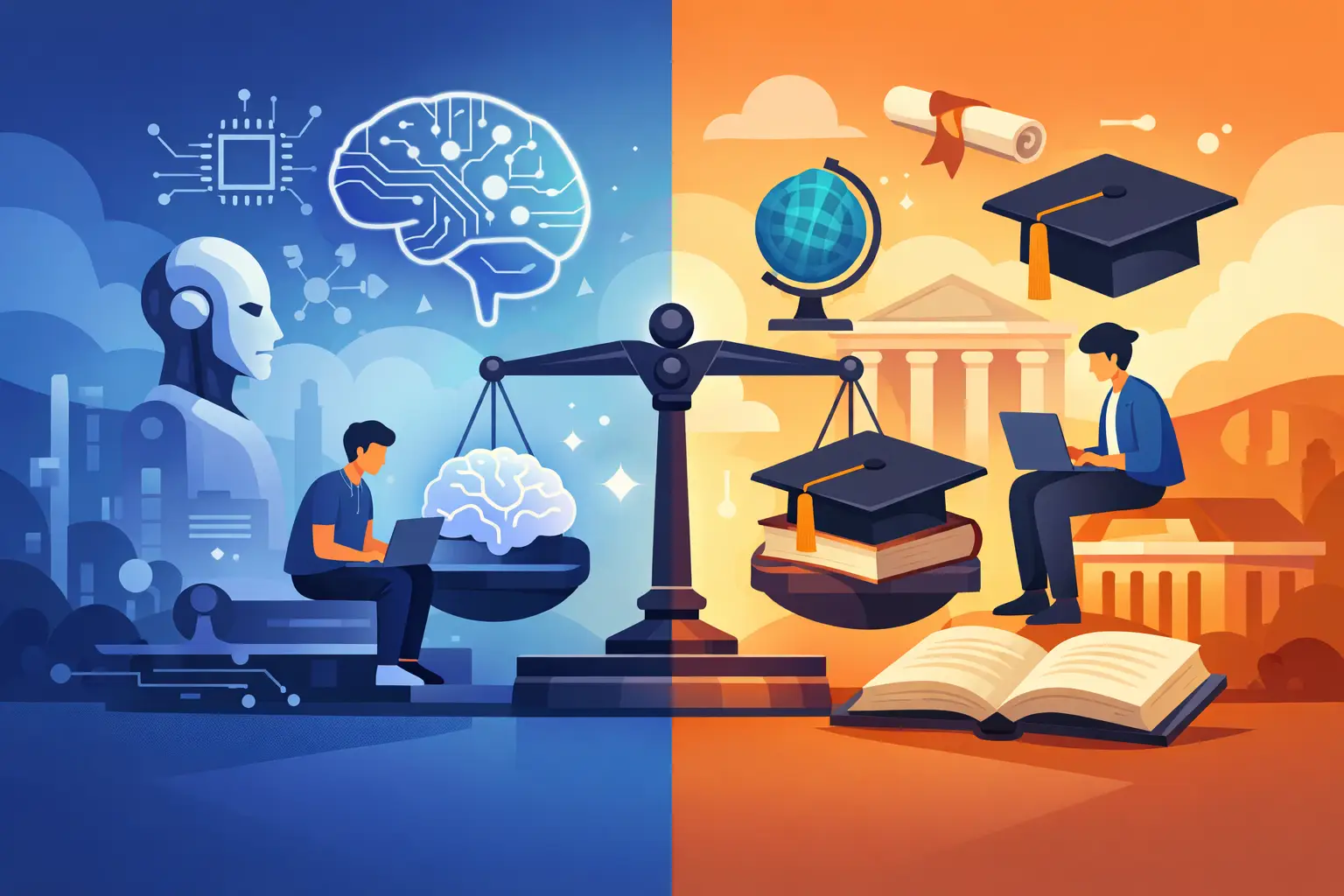
A hiring manager has two candidates in front of them. One has a respected degree but cannot show how they solve current business problems. The other has learned to use AI, built a small portfolio, and can explain exactly how they would save the team time or help it grow revenue. That is the real question behind AI skills vs college degrees: not which path is more impressive, but which combination helps you create value in a changing economy.
For millions of Americans, a college degree remains a source of pride, discipline, and opportunity. It can also come with significant cost and no longer guarantees the career stability it once seemed to promise. At the same time, learning AI tools can open doors quickly, but a collection of online certificates is not a complete substitute for judgment, experience, or professional credibility.
The strongest path forward is not built on fear of being replaced. It is built on becoming more useful, more adaptable, and more capable of leading where work is headed.
Why the AI Skills vs College Degrees Debate Feels Urgent
Artificial intelligence is changing the daily work of accountants, marketers, salespeople, healthcare administrators, designers, managers, tradespeople, and small-business owners. Much of that change is not about eliminating an entire profession overnight. It is about changing what high performance looks like inside that profession.
A professional who knows how to ask better questions, evaluate AI-generated work, organize information, and use automation responsibly can often produce more in less time. That advantage matters. Companies are under pressure to move faster, control costs, and serve customers better. They will increasingly look for people who can pair human judgment with modern tools.
This creates understandable anxiety for people who spent years earning degrees and building careers under older rules. But it also creates a powerful opening. You do not need to be an engineer to benefit from AI. You need to understand where the technology can improve your work, where it can make mistakes, and where your personal expertise still makes the difference.
The American Dream has never been about standing still. It has been about gaining skills, taking responsibility, and finding a way forward when the economy changes. AI makes that principle more relevant, not less.
What a College Degree Still Provides
The argument that college is worthless is as misleading as the idea that every degree guarantees success. Degrees serve real purposes, especially in careers that require formal licensing, deep technical foundations, or established professional trust.
For physicians, nurses, attorneys, engineers, teachers, accountants, and many scientific roles, higher education is not optional. It is part of the pathway to competence, public safety, and legal eligibility. Even in fields without licensing requirements, a degree can signal persistence, exposure to complex ideas, and the ability to work through long-term commitments.
College can also provide networks. A professor, classmate, internship supervisor, or alumni connection may lead to an opportunity that never appears on a job board. For a young person still exploring interests, the structure of a strong program can offer time to mature, communicate, and learn how to think.
But the value depends on the program, the cost, the field, and the student’s plan. Borrowing heavily for a degree with no clear career strategy can limit freedom for years. A degree earned without practical experience can leave a graduate qualified on paper but unsure how to compete in an interview.
The smarter question is not, “Is college worth it?” It is, “What return will this specific education create for the life and work I want to build?”
AI Skills Are Becoming a Career Multiplier
AI skills are not just knowing how to type a prompt into a chatbot. The lasting skills are more practical and more valuable. They include identifying repetitive work, giving clear instructions, checking outputs for errors, protecting sensitive information, and deciding when a human should make the final call.
A project manager might use AI to turn meeting notes into a first draft of a project plan, then apply experience to resolve priorities and risks. A real estate professional might use it to organize market research, then rely on local knowledge and trust to guide a client. A small-business owner may use AI to brainstorm customer messages, analyze feedback, or create operating checklists, freeing up more time for relationships and decisions.
The tool can accelerate the first draft. It cannot replace accountability.
That distinction is crucial. Employers and clients do not simply need people who can generate more words, images, or spreadsheets. They need people who can produce accurate work, spot weak assumptions, and connect output to a real goal. AI rewards people who bring context, standards, and judgment to the table.
The skills beneath the tools
Specific AI platforms will change. The underlying capabilities will travel with you. Learn to frame a problem clearly. Learn to break a large task into smaller steps. Learn to verify claims and recognize weak information. Learn to communicate with customers and colleagues in a way that builds confidence.
These are human strengths amplified by technology. They are also the qualities that make someone harder to overlook when a company is deciding who is ready for greater responsibility.
When Degrees Matter More and When Skills Matter More
There is no universal answer because careers have different entry gates. If your goal is to practice medicine, design a bridge, become a licensed counselor, or enter a profession with strict educational requirements, a degree is foundational. AI should be an addition to your education, not an attempted shortcut around it.
If you want to work in sales, digital marketing, operations, customer success, content, entrepreneurship, or many business roles, demonstrated ability may carry as much weight as formal credentials. A portfolio, a measurable result, a strong referral, or a thoughtful case study can make a serious impression.
For many mid-career professionals, returning to college may not be the best first move. A targeted learning plan, applied projects, and evidence that you can improve a process at work may generate a faster return. That does not diminish education. It recognizes that education comes in more than one form.
The best candidates often combine both worlds. They use formal education to develop foundations and credibility, then continue building practical skills as the market evolves. Their learning does not end at graduation because opportunity does not wait for a syllabus.
Build Proof, Not Just Credentials
Whether you have a degree, are pursuing one, or chose a different route, your next advantage is proof. Proof turns learning into opportunity because it gives employers, clients, and partners something concrete to evaluate.
Start with a work problem you understand. Perhaps your team spends too long summarizing customer calls, creating routine reports, responding to common questions, or preparing proposals. Explore how AI can improve one part of that process while keeping a person responsible for quality and approval.
Then document what happened. What was the original problem? What did you try? How did you check for accuracy? What time, cost, or frustration did it reduce? You do not need a flashy technical project. A clear before-and-after story is often more persuasive than an impressive-sounding certificate.
A practical learning plan can include four actions:
- Choose one AI use case connected to the work you want to do.
- Practice with real scenarios until you can explain your process clearly.
- Keep a simple record of results, lessons, and mistakes corrected.
- Share your value through a portfolio, interview story, performance conversation, or business offer.
This approach also protects you from chasing every new trend. You are not learning AI for the sake of appearing current. You are learning it to become more capable and create better outcomes.
Do Not Let AI Become an Excuse to Stop Thinking
There is a risk on the skills side of this debate. People can confuse speed with competence. AI can produce confident answers that are incomplete, biased, outdated, or simply wrong. Using it without verification can damage your reputation faster than avoiding it altogether.
That is why character and judgment will matter more, not less. The people who rise will be the ones who use technology responsibly, tell the truth about what they know, protect private information, and take ownership of the final result. Those habits build the trust that no software can manufacture.
Your education, whether it came from a university, a trade program, military service, a job, a business, or independent study, should make you a better thinker and a better contributor. AI can help you move faster. It cannot decide what is worth building or what kind of person you want to become while building it.
Your Future Is Built Through Continued Learning
The choice between a degree and AI skills is often framed as a battle between the past and the future. It is better understood as a decision about how you will keep growing. A degree may be the right investment, a valuable foundation, or a necessary credential. AI skills may be the fastest way to increase your value in your current role or create a new income path.
Do not wait for the economy to tell you that you are behind. Choose one meaningful skill, apply it to a real problem, and let your results become evidence of your ambition. The future will favor people who keep learning with purpose and use new tools to serve others better.
