
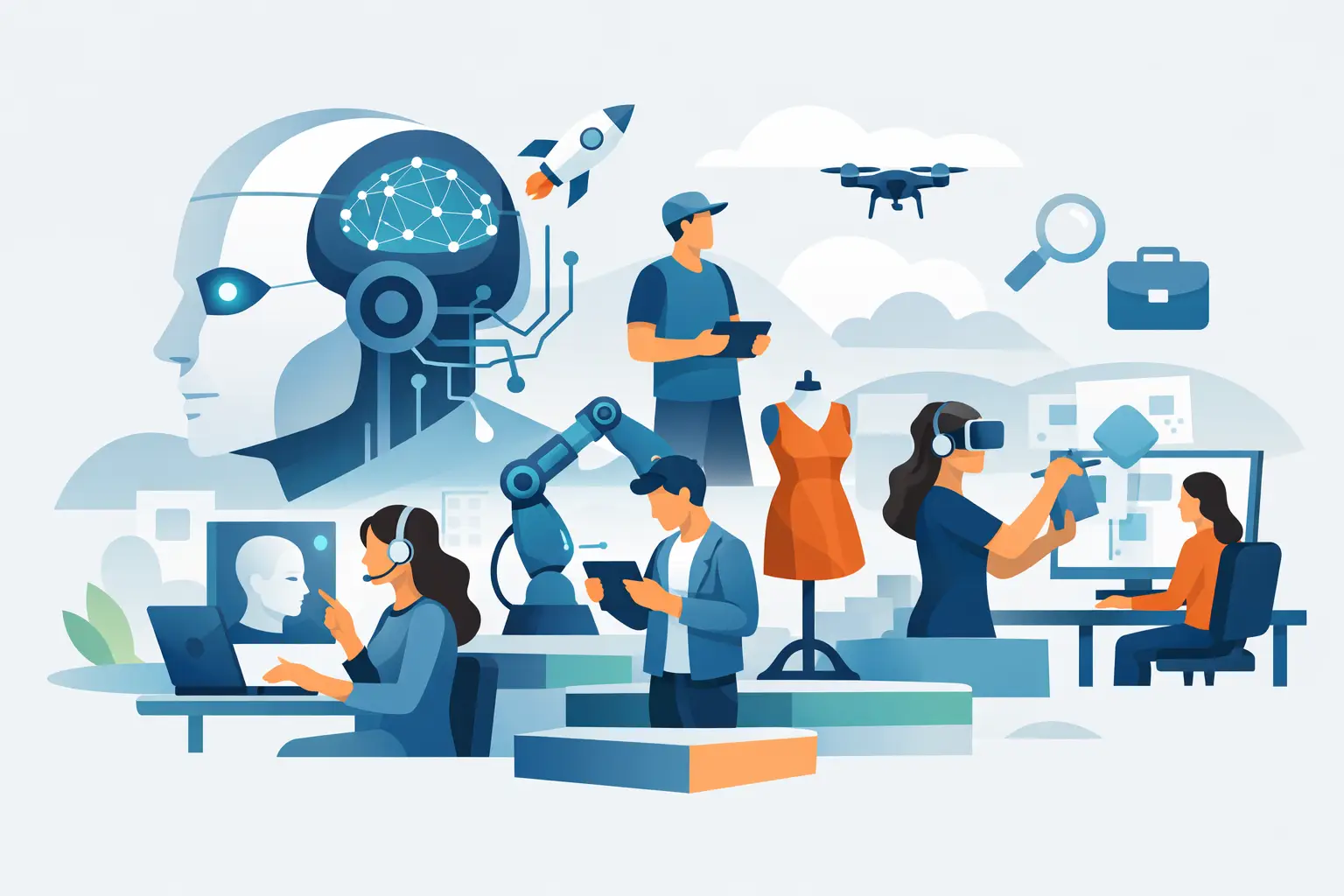
A customer service representative who learns to improve an AI assistant can become the person who redesigns an entire support operation. A marketer who knows a local industry can build AI-powered content systems for small businesses. A teacher who understands how people learn can help organizations create responsible training with new tools. These are not distant possibilities. They are real examples of AI creating new careers, and they point to a larger truth: technology changes the value of work, but it also creates new ways for capable people to contribute.
For Americans who want greater freedom, security, and upward mobility, the question is not whether AI will affect their field. It already is. The better question is where human judgment, industry knowledge, communication, and initiative can meet this technology. That intersection is where new career paths are taking shape.
Why AI Creates Work as It Changes Work
AI can automate portions of a job, especially repetitive writing, sorting, research, scheduling, and data tasks. But businesses do not simply need software that produces an answer. They need people who can decide whether the answer is useful, accurate, ethical, on-brand, and appropriate for a customer or situation.
That gap between what a tool can generate and what an organization can confidently use creates opportunity. AI needs direction. It needs quality control. It needs practical integration into existing processes. And it needs people who understand the real-world consequences when it gets something wrong.
The strongest new roles are often not reserved for computer scientists. They are built by people who combine a working knowledge of AI with experience in healthcare, sales, construction, education, finance, logistics, legal services, hospitality, or another field. Domain knowledge is no longer just a resume line. It is a competitive advantage when paired with the ability to use AI productively.
Examples of AI Creating New Careers Across the Economy
AI workflow designer
An AI workflow designer helps a company decide where AI belongs in its daily operations. This may include mapping a process, choosing tasks that can be assisted by AI, setting review checkpoints, and training employees to use the new system.
Consider a property management company drowning in maintenance requests. An AI workflow designer might build a process that categorizes requests, drafts tenant updates, identifies urgent issues, and sends complex cases to a human manager. The value is not in pressing a button. The value is in understanding the business process well enough to make the system reliable.
This work can be performed by operations managers, project coordinators, virtual assistants, and consultants who develop practical AI skills. It rewards organized thinking and a willingness to improve how work gets done.
AI content editor and brand reviewer
AI can produce first drafts quickly. That does not mean a business should publish everything it generates. Companies need people who can turn rough output into accurate, credible, useful communication that sounds like them.
An AI content editor reviews articles, sales materials, social posts, training documents, and customer messages. They fact-check claims, remove generic language, protect the brand voice, and ensure material serves a real audience. In regulated fields, they may also verify that content respects internal standards and legal requirements.
Writers, journalists, marketers, and communications professionals have a clear opening here. Their craft is becoming more valuable when they learn to direct AI rather than compete with it on speed alone. The future belongs to professionals who can produce both more and better work.
AI trainer and data quality specialist
AI systems learn from patterns in data, but data does not arrive clean, complete, or free of bias. A data quality specialist reviews information, labels examples, tests outputs, and helps teams identify errors before those errors affect customers or decisions.
In healthcare, this might mean checking whether an AI-generated patient summary leaves out important context. In retail, it could mean evaluating whether product recommendations make sense. In manufacturing, it may involve validating images used to identify equipment defects.
These roles demand care, consistency, and subject-matter knowledge. They also show why AI does not remove the need for human responsibility. The more organizations rely on automated systems, the more they need trusted people to help those systems earn that reliance.
AI adoption coach
Many employees are willing to use AI but do not know where to begin. Others worry that a new tool will expose them to mistakes, reduce their value, or add one more confusing system to their day. An AI adoption coach helps people move from uncertainty to useful action.
This person may lead short workshops, create simple prompt libraries, document safe practices, and meet with teams to identify time-consuming tasks. The best coaches do not overwhelm people with technical jargon. They show a payroll clerk how to draft clearer employee communications, a sales team how to prepare account research, or a manager how to organize meeting follow-up.
Training, human resources, management, and education professionals are well positioned for this path. The ability to teach patiently may become one of the most practical AI skills in the workplace.
AI compliance and risk coordinator
As businesses use AI for hiring, customer service, financial analysis, and sensitive records, they must ask harder questions. Is private information protected? Can a decision be explained? Is the output biased? Who approves the final result? What happens when the system is wrong?
An AI compliance and risk coordinator helps create policies, approval processes, documentation, and employee guidance. Larger organizations may hire specialized professionals for this work. Smaller businesses may rely on consultants who can translate broad rules into everyday operating practices.
This career path is especially relevant for people with backgrounds in law, cybersecurity, human resources, finance, governance, or operations. It may not sound flashy, but trust is a growing asset. Companies that use AI carelessly can lose customers, face costly errors, and damage their reputation.
Industry-specific AI entrepreneur
Some of the most promising careers will not come with a traditional job title. They will be created by entrepreneurs who use AI to solve a narrow, expensive problem for a specific market.
A former insurance professional might create a service that helps independent agents organize policy comparisons and client follow-ups. A contractor could build an estimating and proposal system for local trades businesses. A bilingual professional might offer AI-assisted customer communication services for companies serving multilingual communities.
The opportunity is not to call yourself an AI expert without a business purpose. It is to understand a customer problem deeply, use AI where it genuinely saves time or improves quality, and charge for an outcome people value. Small businesses do not need more hype. They need solutions that help them sell, serve, and operate better.
How to Position Yourself for an AI-Enabled Career
You do not need to quit your job or become a programmer to begin. Start with the work you already understand. Identify one recurring task that takes too long, creates errors, or keeps people from higher-value work. Then test whether AI can help with research, drafting, organization, analysis, or communication while keeping a human review step in place.
Build proof, not just knowledge. Save examples of improved processes, clearer documents, faster turnaround times, or better customer experiences. A small portfolio of real results is more persuasive than a long list of tools you have tried.
It also pays to choose a lane. General AI familiarity is useful, but a clear combination is stronger: AI plus real estate operations, AI plus sales enablement, AI plus workforce training, AI plus bookkeeping, or AI plus customer support. Your experience gives you context that a generalist may not have.
There are trade-offs. Some entry-level AI tasks may be temporary as tools improve, and certain roles will require ongoing learning. Not every new job will carry a dramatic title or appear on a job board right away. Many opportunities will emerge inside existing positions, freelance services, and businesses that have not yet recognized what they need. That is precisely why initiative matters.
The American Dream has always asked people to see possibility where others see only change. AI is not a guarantee of success, and it should never replace judgment, character, or hard work. But for those willing to learn, experiment, and bring real value to real people, it can become a powerful tool for building the career they want next.
