
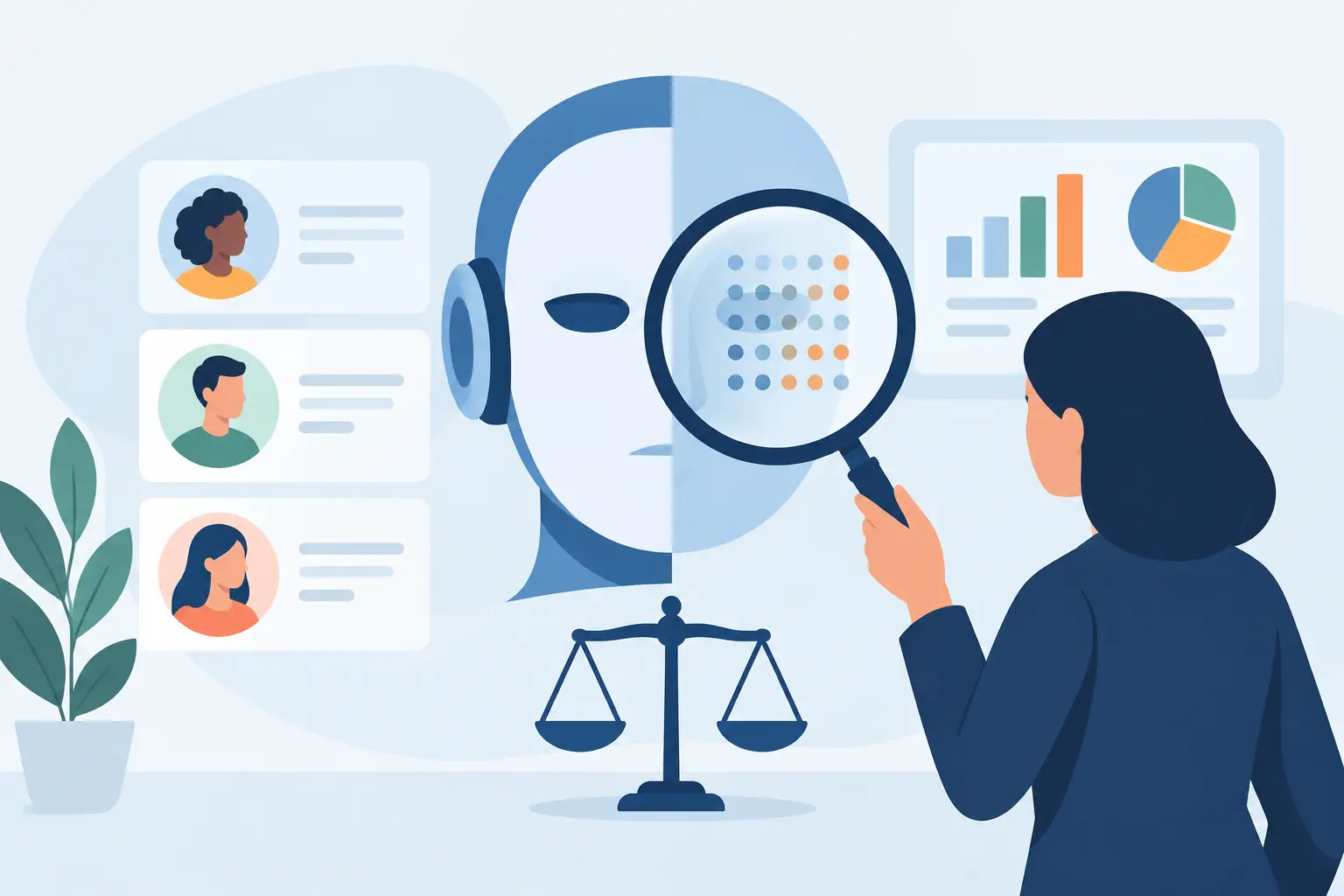
An AI tool can write an impressive job description, rank a stack of resumes, suggest a loan offer, or decide which customer receives an urgent response. But polished output is not the same as fair output. Learning how to audit AI bias gives you a practical advantage: you can use powerful technology without handing over your judgment, reputation, or values.
For professionals and small business owners, this is not just a technical issue for major corporations. Bias can shape who gets noticed, hired, approved, served, promoted, or left behind. The good news is that you do not need to be a data scientist to ask better questions, spot warning signs, and make smarter decisions.
What AI bias actually looks like
AI bias occurs when a system produces consistently unfair or less accurate outcomes for certain people or groups. That unfairness may be connected to race, gender, age, disability, income, geography, language, or another characteristic. It may also affect people whose backgrounds simply differ from the data the system has seen before.
Bias is not always the result of bad intentions. AI learns patterns from human-created data, and human systems have never been perfectly neutral. If past hiring decisions favored people from certain schools, neighborhoods, or career paths, an AI trained on those decisions may learn to reward the same patterns. It can turn yesterday's limits into tomorrow's automated rule.
That is why AI bias deserves attention from anyone building a career or business in an AI-driven economy. Technology should expand opportunity, not quietly narrow it.
How to audit AI bias: Start with the decision
The strongest audit begins before you test the tool. First, define the decision the AI is influencing and the stakes attached to it. An AI assistant that suggests social media captions requires a lighter review than a system that ranks job candidates or flags insurance claims.
Ask yourself: What is this tool deciding, recommending, scoring, or filtering? Who could be helped or harmed by an incorrect result? Will a person make the final decision, or will the AI output become the decision in practice?
This distinction matters because people often say, “The human is still in the loop,” while treating the AI recommendation as unquestionable. If a manager only interviews the top candidates selected by software, the software has real power, even if a human technically makes the final hire.
Next, state what fair performance should look like for the task. For example, a hiring tool should identify qualified candidates based on relevant skills, not reward applicants because their resumes resemble employees hired in the past. A customer service tool should provide equally useful answers to customers who write with different accents, grammar levels, or cultural references.
Without a clear definition of success and fairness, an audit becomes guesswork.
Review the inputs before trusting the outputs
Every AI system reflects its inputs. Those inputs may include training data, prompts, customer records, resumes, performance reviews, search history, and the criteria chosen by the people using the tool. This is where many problems begin.
Look for data that may stand in for a protected trait. A ZIP code, for instance, can act as a proxy for race or income. A college name can reflect access and family resources as much as individual capability. Gaps in employment may reveal caregiving, disability, military service, or economic hardship without explaining a person's actual ability to do the job.
Also examine what is missing. If an AI sales assistant was trained mostly on communications from large corporate clients, it may misunderstand the needs of independent contractors, rural businesses, or customers who communicate differently. Incomplete representation can create uneven results even when no one intended discrimination.
For everyday use of generative AI, inspect your prompts as carefully as you inspect the answer. A prompt such as “Write a professional candidate profile” can invite the system to rely on narrow assumptions about what professionalism looks like. Give clear, job-related criteria instead. Ask for evidence of skills, outcomes, communication requirements, and experience relevant to the role.
Test the same task across meaningful differences
The most practical way to audit an AI tool is to run controlled comparisons. Keep the core facts the same, then change one variable that should not affect the result. Watch for meaningful differences in tone, quality, recommendations, scores, or access.
For a hiring workflow, you might test comparable resumes with different names, career breaks, schools, locations, or wording styles. For a customer-facing chatbot, test questions written in plain English, regional phrasing, imperfect grammar, and languages your business serves. For an AI image generator used in marketing, test how it depicts leaders, workers, families, and entrepreneurs across identities.
You are not looking for perfection in a single response. You are looking for patterns. Does the tool consistently describe one group as more capable, trustworthy, polished, risky, or qualified than another when the relevant facts are the same? Does it offer better detail and more encouragement to some users than to others?
Document each test. Save the prompt, output, date, model or tool version, and your observations. A simple spreadsheet is enough for many small teams. Documentation turns a vague concern into evidence you can review, share, and act on.
Measure impact, not just intent
A biased system can sound respectful while still producing unequal outcomes. That is why the audit must move beyond whether an answer feels offensive. Look at who advances, who gets filtered out, who receives lower scores, and who needs to work harder to get the same useful result.
If you have enough data, compare outcomes among relevant groups. Are similarly qualified applicants moving forward at similar rates? Are certain customers being routed to human help more often? Are false positives or false negatives concentrated in one population?
Numbers require care. Small samples can mislead, and every difference is not proof of discrimination. Context matters. Still, ignoring differences because they are inconvenient is not leadership. Treat unexpected gaps as a signal to investigate.
For high-stakes decisions involving employment, housing, credit, health, education, or legal matters, bring in qualified legal, compliance, or technical experts. The cost of a deeper review is often far lower than the cost of a harmful decision made at scale.
Put human judgment back where it belongs
An audit is only useful if it changes behavior. If you find bias, do not simply add a disclaimer and move on. Adjust the prompt, remove irrelevant variables, revise the process, retrain users, or choose a different tool. In some cases, the right answer is to stop using AI for that decision until you have safer safeguards in place.
Human review works best when reviewers have authority, clear criteria, and time to challenge the system. Telling an overwhelmed employee to “use judgment” after presenting an AI score as objective is not a meaningful safeguard. Give people a process for questioning recommendations and correcting errors.
Transparency helps, too. Let customers, applicants, and employees know when AI plays a meaningful role in a decision. Offer a way to request clarification or human review when appropriate. People do not expect every system to be flawless. They do expect to be treated with dignity when the system gets something wrong.
Make bias auditing a business habit
AI systems change. Vendors update models, your data changes, employee practices shift, and new use cases appear. A one-time audit can become outdated quickly.
Set a review schedule based on risk. A low-stakes writing assistant may need periodic spot checks. A tool used for hiring, performance management, or financial decisions deserves regular and documented testing. Review it whenever you change the tool, introduce a new data source, expand to a new audience, or receive a complaint that points to an uneven experience.
This practice can become a competitive strength. Businesses that use AI responsibly build trust with customers and create better conditions for talented people to contribute. Professionals who understand both the promise and the limits of AI become more valuable to employers, teams, and clients.
The future will reward people who know how to work with AI without surrendering their principles to it. Ask what the system is learning, whom it serves well, and whom it may overlook. That habit protects opportunity, strengthens your judgment, and keeps technology working for the American Dream rather than against it.
