
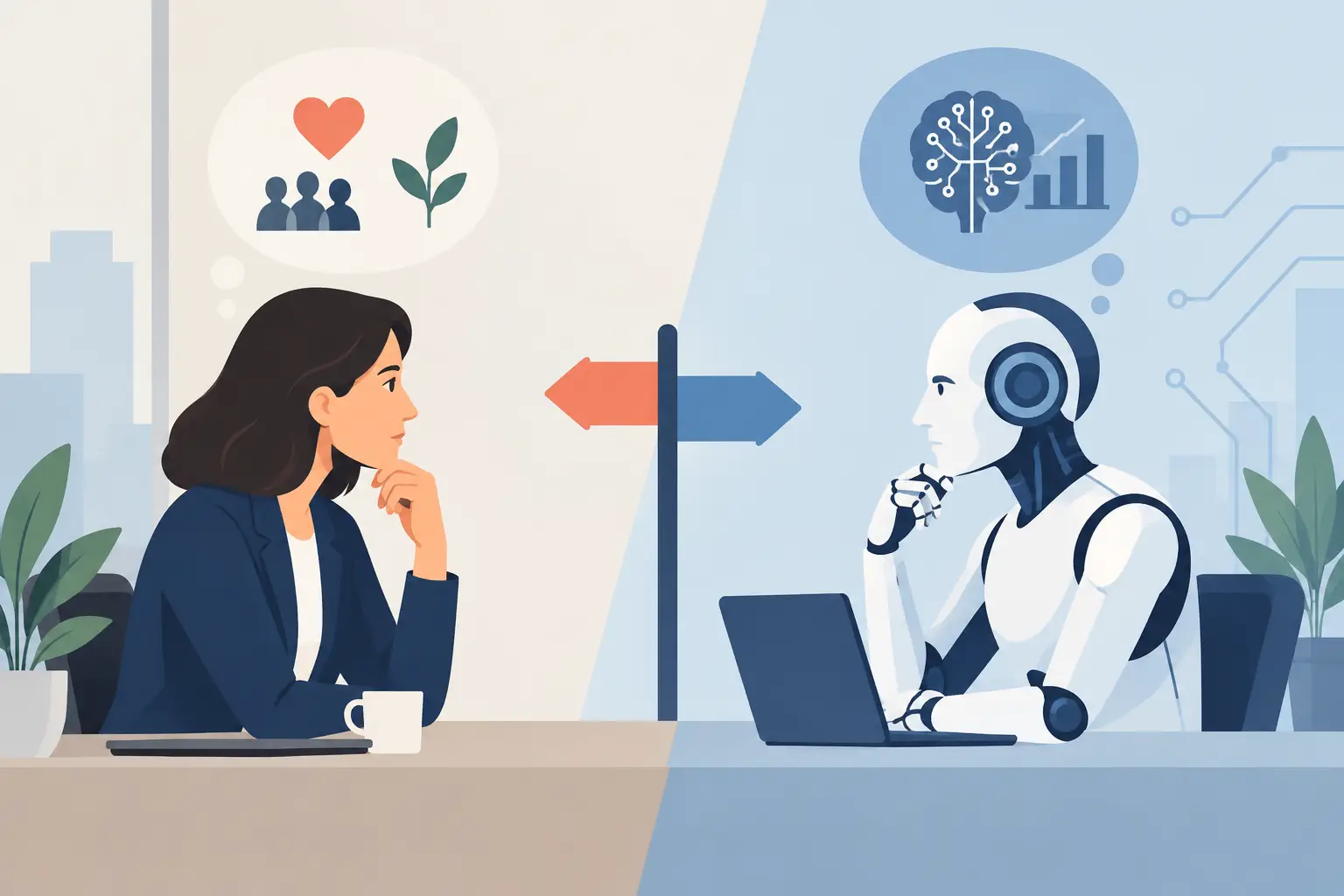
A loan application is approved in seconds. A hiring platform ranks candidates before a manager reads a résumé. A customer service system recommends the next best response while an employee is still listening to the customer’s problem. Human judgment versus algorithms is no longer an abstract debate for technology companies. It is a daily reality for American workers, business owners, and leaders deciding how they will create value in an AI-driven economy.
The wrong question is, “Will algorithms replace people?” The better question is, “Where does my judgment make the algorithm more useful, more responsible, and more profitable?” That question shifts the conversation from fear to opportunity.
Algorithms can process patterns at extraordinary speed. But people bring context, responsibility, imagination, and the ability to decide what matters when the data is incomplete. The future belongs to those who learn to work on both sides of that line.
Human Judgment Versus Algorithms Is Not a Winner-Take-All Battle
An algorithm is a set of instructions designed to identify patterns and produce an output. It can score, predict, sort, recommend, and automate. Given enough relevant information, it may do those tasks faster and more consistently than a person.
That capability matters. A small business owner can use AI to analyze customer feedback, draft marketing ideas, forecast inventory needs, and organize routine work that once consumed hours. A professional can use it to prepare for meetings, summarize research, identify gaps in a proposal, or practice difficult conversations. Used well, algorithms create leverage.
But an algorithm does not carry the consequences of its recommendation. It does not sit across from a worried client, notice the tension in a room, or decide that a technically efficient choice violates the values of the organization. It does not possess ambition, integrity, or a personal stake in the future it helps shape.
That distinction is not sentimental. It is economic. The more routine work becomes automated, the more valuable distinctly human capabilities become. Clear thinking, sound judgment, trust-building, leadership, negotiation, creativity, and moral responsibility are no longer soft skills at the edge of a career. They are central to career resilience.
What Algorithms Do Exceptionally Well
It is wise to respect what AI systems can do. Denying their strengths does not protect your career. It only delays your ability to use them.
Algorithms are especially effective when the task is repetitive, measurable, and based on large quantities of structured information. They can compare thousands of data points without fatigue. They can flag patterns that a busy person might miss. They can generate a first draft, offer multiple options, and reduce the friction of getting started.
For example, an entrepreneur might ask an AI tool to identify common objections in customer reviews. That is not a replacement for knowing the customer. It is a faster way to surface useful signals. A manager might use AI to create a training outline, then apply personal experience to make it relevant to the actual people on the team.
The practical advantage is speed. The strategic advantage is capacity. When you spend less time on low-value repetition, you have more room to serve customers, build relationships, solve higher-level problems, and pursue opportunities that can change your income and influence.
Still, speed is not wisdom. A fast answer can be wrong. A polished recommendation can rest on incomplete data. An automated decision can produce unfair results if the historical patterns behind it contain bias or if the system fails to account for a real-world exception.
Where Human Judgment Still Carries the Weight
Human judgment becomes most important when the stakes are high, the information is uncertain, or the situation involves people rather than just numbers.
Consider hiring. An algorithm may help screen applications based on stated criteria. But it cannot fully measure character, coachability, resilience, or whether someone will earn trust within a particular team. Those qualities often determine whether a hire succeeds.
Consider personal finance. Automated tools can help organize spending, model savings scenarios, or explain investment concepts. Yet no system can fully define what financial security means for your family, your risk tolerance, or your long-term goals. Those decisions require values, not merely calculations.
The same is true in customer service, health care, education, and leadership. Data can inform a decision, but people must remain accountable for the decision. That accountability is where trust lives.
This does not mean human intuition should always overrule data. Intuition can be biased, emotional, and overly confident. The strongest judgment is informed judgment. It listens to the evidence, challenges assumptions, asks better questions, and knows when the available information is not enough.
The Essential Skill: Knowing When to Question the Output
As AI becomes more common, one of the most valuable professional habits will be productive skepticism. Do not treat an AI-generated answer as a final verdict simply because it sounds confident.
Ask what information the system used. Ask what it may be missing. Ask whether the recommendation fits the actual goal, customer, or situation. Then use your experience to improve the result.
This is how a worker becomes more than an operator of technology. This is how a worker becomes a decision-maker who can direct technology toward a meaningful outcome.
Build a Career That Uses Both Intelligence and Judgment
You do not need to become a software engineer to benefit from AI. You need to become more intentional about the work you bring to the table.
Start by looking at your weekly responsibilities. Which tasks are repetitive enough for an AI tool to accelerate? Which tasks require your relationship skills, industry knowledge, judgment, or personal accountability? The goal is not to hand over your work blindly. The goal is to offload the routine pieces so you can raise the level of your contribution.
If you are in sales, let AI help you research an account or prepare a first-pass follow-up. Then bring human insight to the conversation. Listen for the concern behind the objection. Understand the customer’s priorities. Make a promise you are willing to stand behind.
If you run a small business, use AI to organize ideas and reduce administrative drag. Then spend the saved time strengthening the experience only you can create: better service, a clearer vision, a more trusted reputation, and a deeper understanding of your market.
If you are changing careers, use AI as a learning partner. Ask it to explain unfamiliar concepts, simulate interviews, improve the structure of your résumé, and identify skills connected to your existing experience. But choose your direction based on your own goals, values, and willingness to grow.
The opportunity is not merely to work faster. It is to become harder to replace because you can combine technology with discernment.
The Leadership Question Behind Every Algorithm
Every organization using AI eventually faces a leadership question: What should never be automated without meaningful human review?
The answer will differ by industry. A recommendation for a movie carries little risk. A recommendation affecting a person’s job, housing, health, credit, or legal standing carries much more. The higher the consequence, the more human oversight and accountability are needed.
Wise leaders will not reject algorithms because they are imperfect. Human systems are imperfect too. They will set clear standards for how technology is used, who reviews consequential decisions, and how people can challenge an outcome that seems wrong.
That approach creates a competitive advantage. Customers and employees want efficiency, but they also want to be treated fairly. They want to know that someone with responsibility and common sense is still paying attention.
Make AI Your Advantage, Not Your Excuse
The American Dream has always required adaptation. New tools change the nature of work, but they also create new paths for people who are willing to learn, act, and take ownership. AI is one of those tools.
Do not wait for algorithms to define your value. Build the habits they cannot supply: curiosity, courage, discipline, empathy, and the willingness to make a decision when no perfect answer exists. Use technology to expand your reach, then use human judgment to decide what is worth reaching for.
