
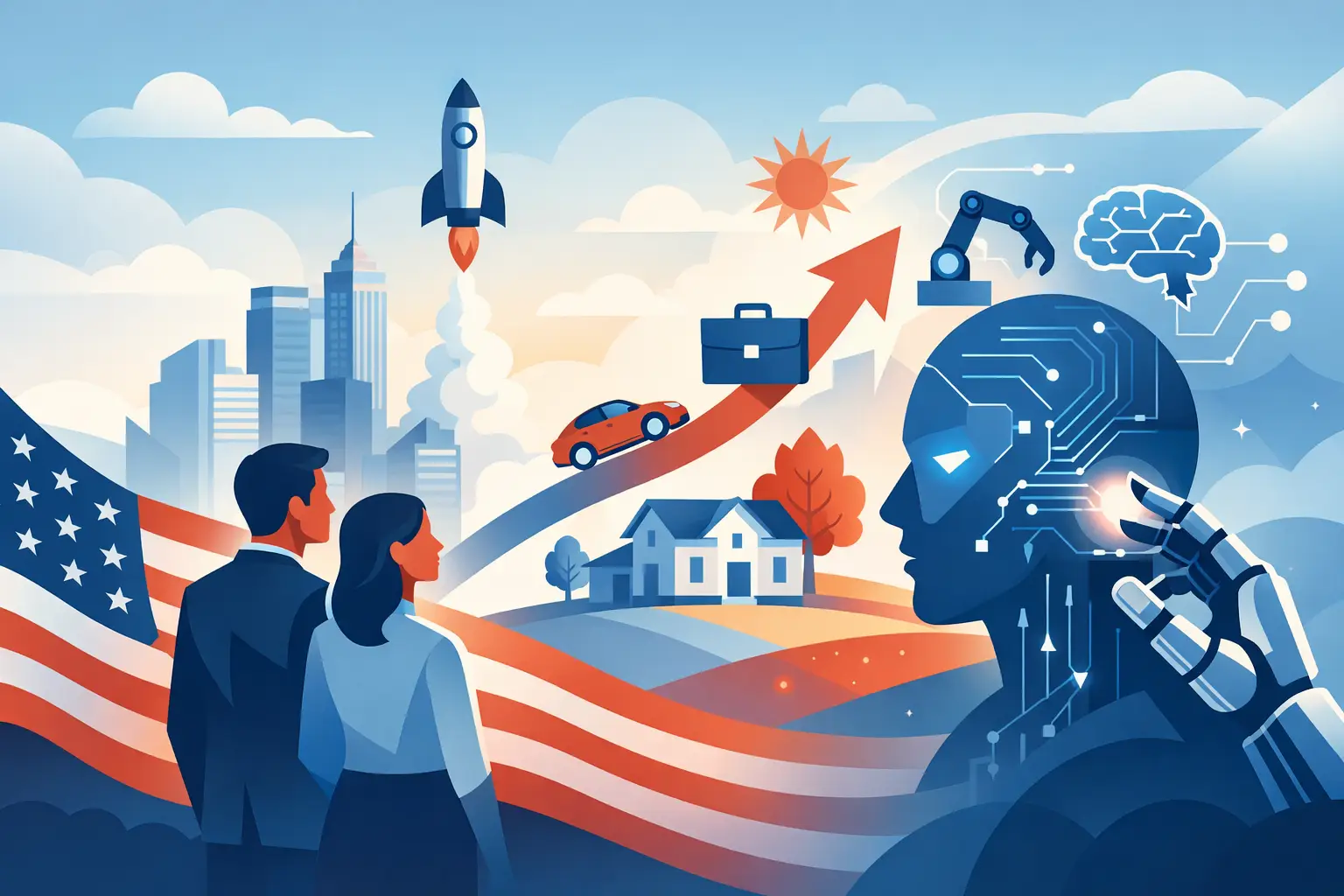
A job description can change faster than a person’s confidence. A small business can watch a new AI tool perform work that once required hours. For many Americans, that creates a difficult question: if technology is changing the rules, does hard work still lead somewhere? The American Dream mindset answers yes, but with a condition. Hard work must now be paired with adaptability, initiative, and a willingness to learn what the future rewards.
The American Dream was never meant to be a guarantee that life would stay familiar. It has always been a belief that people can build a better future through effort, ownership, ingenuity, and personal responsibility. AI does not erase that belief. It raises the standard for how we act on it.
What the American Dream Mindset Means Now
At its core, the American Dream mindset is the conviction that your starting point does not have to determine your destination. It is not blind optimism, and it is not the belief that every outcome is fully within your control. Economic conditions, family obligations, education, health, and access to opportunity all matter.
But mindset still matters because it shapes what you do with the choices in front of you. A person with an opportunity-focused mindset asks, “What can I learn? What can I create? Where can I become more valuable?” A person ruled by fear asks only, “What will be taken away?”
AI has made this difference more visible. The people who treat AI as a force that only threatens jobs may delay learning until they are forced to react. The people who see it as a tool can begin using it to improve their writing, research, customer service, planning, analysis, and creative output. They do not need to become programmers to benefit. They need to become capable users of powerful tools.
That is a modern form of self-reliance: not doing every task alone, but learning how to direct technology toward a meaningful goal.
Why AI Changes the Opportunity Equation
For decades, career advancement often depended on gaining experience slowly, finding the right mentor, or waiting for a promotion. Those paths still matter. Yet AI gives motivated people a new way to shorten the distance between curiosity and competence.
A marketing coordinator can use AI to draft campaign ideas and spend more time refining strategy. A sales professional can prepare more effectively for client conversations. A small business owner can organize customer questions, test messaging, and create first drafts of operating materials without hiring a large team. A career changer can use AI to understand unfamiliar industries and practice communicating their transferable skills.
The opportunity is real, but so is the trade-off. AI can help people produce more work, but more output is not automatically more value. If you use it carelessly, you may create generic material, share inaccurate information, or weaken the judgment that makes your work trustworthy. The advantage goes to people who combine AI speed with human standards.
That means checking facts, protecting confidential information, understanding your audience, and knowing when a human conversation matters more than an automated response. The future will reward people who can use technology without surrendering their judgment to it.
Build Skills That Make You Harder to Replace
No one can promise that a specific role will remain unchanged. The better goal is to become someone who can create value across changing roles. That requires a commitment to skills that travel well from one job, industry, or business idea to another.
Communication remains one of those skills. The ability to explain a problem clearly, persuade a customer, lead a meeting, or turn complex information into a useful decision will remain valuable. AI can generate a draft, but it cannot fully replace earned trust, context, and accountability.
So does problem-solving. Employers and clients do not simply need people who can complete instructions. They need people who can recognize what is broken, identify the right question, and move a project forward. AI can offer options. You must decide which option fits the real situation.
Financial literacy belongs in this conversation too. The American Dream is not only about earning more. It is about creating greater freedom with what you earn. Understanding debt, savings, investing, pricing, cash flow, and risk gives you more choices when the economy shifts. A higher income without financial direction can still leave a person vulnerable.
Finally, develop the habit of learning in public and in practice. Take on a project at work. Build a small portfolio. Improve a process for a client. Create a simple service around a skill you have developed. Credentials can help, but demonstrated ability often speaks louder than intention.
Turn Anxiety Into a Personal Action Plan
Technology anxiety is understandable. It becomes harmful when it leads to paralysis. The most productive response is not to predict every change in the labor market. It is to create a plan that improves your position regardless of which changes arrive first.
Start by looking honestly at your current work. Which tasks are repetitive? Which tasks require relationships, judgment, creativity, or leadership? The repetitive work may be the first place AI can save you time. The human-centered work may be where you should deepen your value.
Then choose one practical AI use case connected to your real goals. If you are searching for a job, use it to tailor practice interview questions or organize research on target industries. If you run a business, use it to develop a first draft of customer communications or identify common questions your customers ask. If you are pursuing a promotion, use it to brainstorm ways to streamline a process your team already struggles with.
The key is to move from consumption to application. Reading about AI can be useful, but confidence grows when you use it to solve a real problem and evaluate the result yourself.
Set a simple learning rhythm. Spend time each week improving one capability that increases your earning power or professional range. Consistency matters more than dramatic bursts of motivation. A few focused hours each week can create a meaningful gap between the person who waits for change and the person who prepares for it.
The American Dream Mindset Is Not a Solo Project
Self-reliance does not mean isolation. Many people misunderstand ambition as a private struggle where asking for help signals weakness. In reality, opportunity expands through relationships, mentors, collaborators, customers, and communities that challenge you to grow.
As AI makes information easier to access, trusted relationships may become even more valuable. Information is abundant. Wise guidance, credibility, and personal accountability are not. Build a reputation for being prepared, useful, ethical, and willing to follow through. Those qualities create opportunities that no algorithm can hand you.
This also means thinking beyond a single paycheck. Your career may include employment, freelance work, a small business, investments, or a side project that grows over time. Not everyone should become an entrepreneur, and not every side hustle deserves your energy. It depends on your responsibilities, risk tolerance, and available time. Still, developing multiple ways to create value can strengthen your resilience.
That is the larger message behind Your American Dream: the future should not belong only to the largest companies or the most technical experts. It can belong to people who are willing to learn, act, and build with intention.
Choose Agency Over Certainty
There will be no perfectly safe moment to reinvent a skill, pursue a new role, or test an idea. Waiting for certainty can feel responsible, but it often becomes a quiet excuse to remain stuck. The better approach is measured action: learn enough to begin, protect what matters, and improve as you go.
The American Dream mindset does not demand that you predict the future. It asks you to prepare for it with courage. Use AI as a lever, not a label. Let it help you think faster, serve people better, and create more room for the work only you can do.
Your next opportunity may not arrive in the form you expected. Build the skills, discipline, and confidence to recognize it when it does.
